

Medical library
Home
News and articles
Medical library
Call Ambulance
097 495 2 888
Call Ambulance
097 495 2 888
30 June 2026
Scarlet fever: symptoms, ways of infection, treatment and prevention
What is scarlet fever, how is it contracted. The first signs of scarlet fever. Principle...
30 June 2026
Infectious gastroenteritis in adults and children: causes, symptoms, treatment and preve...
Acute intestinal infection is one of the most common causes of acute gastrointestinal sy...
30 June 2026
Symptoms and first aid for false croup in a child
What is false croup? In medical terminology it is called acute obstructive laryngotrache...
30 June 2026
Polio vaccination: why get it, at what age? How to prepare and what are the possible rea...
Vaccination against polio is the only way to protect a child from this viral disease, th...
30 June 2026
Childhood infections – chickenpox, mumps, rubella, whooping cough, and measles
Childhood infectious diseases are one of the most common reasons for parental concern.
30 June 2026
Causes, symptoms and methods of treatment of SARS and influenza in adults and children
Every year we face the cold and flu season. Some people experience mild illness, while f...
30 June 2026
Flowering allergy in children
Ukraine experiences three waves of plant pollination.
30 June 2026
Influenza: avoid the threat by getting vaccinated!
Acute respiratory viral infections account for 95% of all infectious disease cases world...
30 June 2026
Vaccination: The Most Effective Means of Protection against the Flu for Children and Adu...
Every year, Ukraine sees a significant rise in flu cases during the autumn-winter period...
30 June 2026
When and How Should You Start Complementary Feeding?
Complementary feeding is much more than introducing new foods. Although breast milk or i...
Load more
Article details
Call Ambulance
097 495 2 888

Treatment of protrusion of intervertebral discs of the spine and other regions

How to become our patient
Book a consultation

Protrusion of intervertebral discs is one of the most common diseases today. What is it, how protrusion arises in the sacral spine, how to treat protrusion of intervertebral discs of the lumbar spine: these and many other questions concern not only patients, but also everyone who takes care of own health.

What protrusion is

The spine consists of individual vertebrae. They are mobile because of its muscles and ligaments, as well as intervertebral discs, which are elastic formations located between the vertebrae throughout the whole spine and act as a kind of shock absorbers during loads.

Each disc consists of the following:

  • nucleus pulposus located in the center of a disc;
  • fibrous capsule surrounding the nucleus pulposus from all sides.

This structure of the intervertebral disc is preserved due to the active flow of blood, and that, in turn, is maintained due to active movements. Therefore, exercise therapy in case of protrusion of the vertebrae of the sacral region and other regions is applied not only to treat this pathology, but also to prevent it.


An abrupt decrease in motor activity affects the structure of an intervertebral disc: the composition of its tissues changes, the disc loses its initial elasticity. Besides, with a decrease in human motor activity, the muscles that normally support the spine weaken and lose the role of a corset for the spine, the vertebrae begin to press on each other. Under these circumstances, the nucleus of an intervertebral disc:

  • “is squeezed” out of the intervertebral space;
  • presses on the neurovascular bundles.

Kinds of protrusion

Protrusion of intervertebral discs can be observed in any of the regions of the spine:
  • cervical spine;
  • thoracic spine;
  • lumbar spine;
  • sacral spine.

Often there are combined types of pathology - protrusions can be diagnosed in several segments of the spine (for example, protrusion of the thoracic spine and its lumbar spine).

Also, this pathology is classified according to the direction in which the nucleus of the disc has shifted. Knowledge of the process is important, because it depends on the amount of surgery for protrusion and its outcome. Most often, the terms that indicate such a gradation are unknown to persons without medical education. "Dorsal diffuse disc protrusion - what is it?" - A very reasonable question for patients. Therefore, based on the direction in which the pulpal nucleus has shifted from its normal location, there are:

  • dorsal type of displacement, when the nucleus is displaced towards the back;
  • median protrusion, when the nucleus is displaced towards the central part of the spinal canal;
  • ventral protrusion, when the nucleus is displaced towards the anterior abdominal wall;
  • circular type of displacement, when not a narrow segment of the nucleus is shifted, but most of it around the circumference.

Symptoms of lumbosacral protrusion and other types of pathology

In case of protrusion of an intervertebral disc, the following symptoms arise:
  • continuous back pains;
  • impaired sensitivity;
  • deterioration of the dorsal spine mobility;
  • muscle mass atony.

Protrusion mainly occurs in cervical and lumbar spine. The thoracic spine is rarely affected because the ribs themselves create a rigid frame and the spine is better supported in this area than in others.


The symptoms of lumbosacral protrusion are the most common, because this spinal region feels the greatest load compared to other regions.


A displacement of the nucleus pulposus will not cause symptoms by itself. It occurs in the following cases:

  • the nucleus presses on a vessel and the nerves located in adjacent tissues;
  • a simultaneous inflammatory process.


Pains in case of the circular posterior disc protrusion will be the same as with cervical or thoracic one, the only difference is the localization of symptoms.

Treatment of protrusion

Methods of treatment of protrusion of intervertebral discs are:
  • non-surgical;
  • surgical.

Disc dislocation is considered to be a non-reversible process. However, doctors do not hurry with a surgery and try non-surgical procedures first. The tasks of the treatment are as follows:

  • support of the corresponding spinal region;
  • strengthening of the muscle structure of the dorsal spine;
  • symptomatic treatment, in particular, pain management with anesthetic drugs.

Gymnastics and massage are widely recognized for the treatment of protrusion. They help to slow down the destructive process in the tissues of an intervertebral disc.


Surgical treatment is often inefficient. Even if the protrusion is eliminated, it does not affect the state of an intervertebral disc in any way, in particular, it does not stop its destruction.


The most effective treatment for protrusion of intervertebral discs of the spine is the correction of a person’s lifestyle. Professionally designed sets of exercises helped more than one patient to return to their previous active lifestyle and avoid pain.


Article author: Pavel Nosulich, M.D.

Publication date: 21.04.2020


Read more about

Neurology
Vertebrology

Our services

Neurologist consultation
1670.00 uah.
Adult consultation by orthopaedic surgeon, expert of the sector in the clinic
2240.00 uah.
View all services

Service packages

Our advantages

High qualification
Wide range of medical care in more than 50 medical specialties
Affordable prices
Flexible system of discounts for program services for children and adults
24-hour-a-day work
The contact center informs and records patients 24/7

Our doctors

Buimister Tetiana Hryhorivna
Neurologist
Dzhumik Valentyna Anatoliivna
Neurologist
Zhylinska Tamara Mykhailivna
Neurologist
Lukach Oksana Ivanivna
Neurologist
Mazepina Viktoriia Ivanivna
Neurologist
Matiash Yurii Oleksandrovych
Neurologist
Mytsiuk Oksana Volodymyrivna
Neurologist
Nosulich Pavlo Viktorovych
Neurologist
Korzhan Viktoriia Arkadiivna
Neurologist
Pepenina Iryna Borysivna
Neurologist
Riabtseva Olena Volodymyrivna
Neurologist
See all doctors

Our vertebrologists

Myts Yaroslav Volodymyrovych
Rehabilitation specialist
Stelmakh Ihor Mykolaiovych
Vertebrologist
See all doctors

Our clinics
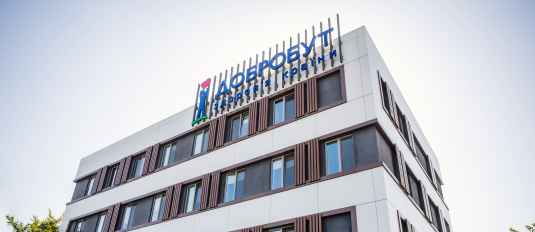
"Dobrobut" Medical Center. Vertebrology
3 Sim'yi Idzykovskykh St (M. Myshyna), Kyiv
Mon-Fri: 8:00-20:00 Sat-Sun: 9:00-17:00
044 495 2 888
097 495 2 888
“Dobrobut” Medical Center for adults in Medmistechko
3 Liubomyra Huzara Ave, Bldg 5, Kyiv
Mon-Fri: 9:00-19:00 Sat: 9:00-16:00 Sun: non-working day
044 495 2 888
097 495 2 888
“Dobrobut” Medical Center for the whole family in Sofiivska Borshchahivka
26 Yabluneva St, Sofiivska Borshchahivka
Mon-Sat: 8:00-20:00 Sun: 9:00-17:00
044 495 2 888
097 495 2 888
“Dobrobut” Medical Center for the whole family in Beresteyska
1 Aviakonstruktora Ihoria Sikorskoho St, Kyiv
Mon-Fri: 8:00-19:00 Sat: 8:00-18:00 Sun: non-working day
044 495 2 888
097 495 2 888
“Dobrobut” Medical Center for the whole family in Golosiiv
10/1 Samiila Kishky (Marshala Konyeva) St, Kyiv
Mon-Sat: 8:00-20:00 Sun: 9:00-17:00
044 495 2 888
097 495 2 888
“Dobrobut” Medical Center for the whole family on Tatarska street
2-E Tatarska St, Kyiv
Mon-Sat: 8:00-20:00 Sun: 9:00-17:00
044 495 2 888
097 495 2 888
“Dobrobut” Medical Center for the whole family in Obolon
16-V Volodymyra Ivasiuka Ave (Heroiv Stalingrada), Kyiv
Mon-Fri: 8:00-21:00 Sat: 8:00-20:00 Sun: 9:00-19:00
044 495 2 888
097 495 2 888
“Dobrobut” Medical Center for the whole family in Svyatoshyn
3-B Sviatoshynska St, Kyiv
Mon-Sat: 8:00-21:00 Sun: 9:00-19:00
044 495 2 888
097 495 2 888
“Dobrobut” Medical Center for adults in Poznyaky
12 Oleksandra Myshuhy St, Kyiv
Mon-Fri: 8:00-20:00 Sat: 8:00-19:00 Sun: 9:00-17:00
044 495 2 888
097 495 2 888
“Dobrobut” Multidisciplinary Hospital 24/7 on Idzikowsky Family street
3 Sim'yi Idzykovskykh St (M. Myshyna), Kyiv
Mon-Fri: 8:00-21:00 Sat: 8:00-20:00 Sun: 9:00-20:00 Dobrobut Diagnostic Laboratory operates 24/7 Adult Trauma Unit operates 24/7 Pediatric Trauma Unit operates from 8:00-20:00 Inpatient Department operates 24/7 Radiology Department operates 24/7 Emergency (Admission) Department operates 24/7
044 495 2 888
097 495 2 888
"Dobrobut" Center of Palliative care
3 Liubomyra Huzara Ave, Bldg 5, Kyiv
Mon-Fri: 9:00-16:00
044 495 2 888
097 495 2 888
See all centers

Do you want to get an online explanation of a doctor from Dobrobut clinic chain?

Download our application in Google Play and App Store


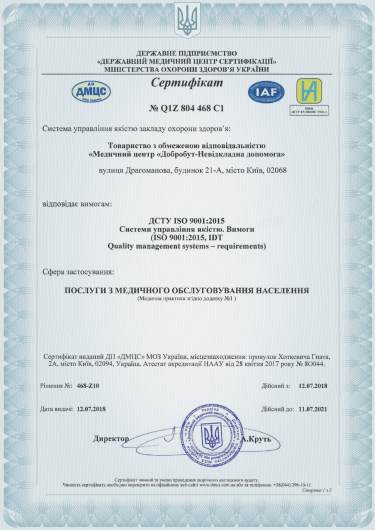
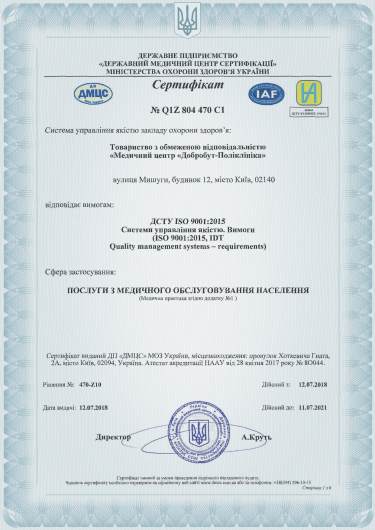
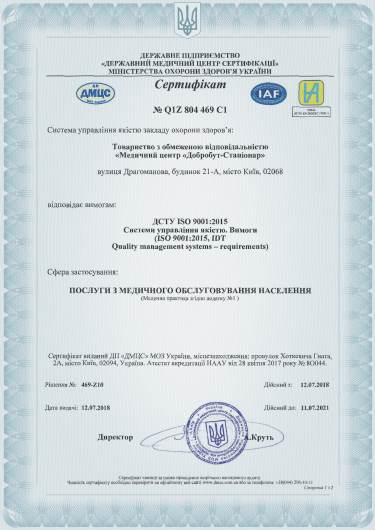
ISO certificates

of Dobrobut clinic chain
*
*
*
ISO certification in more detail

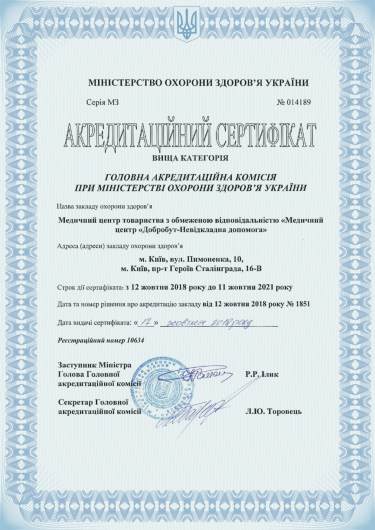
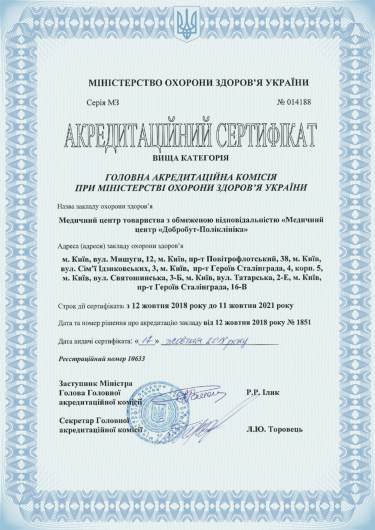
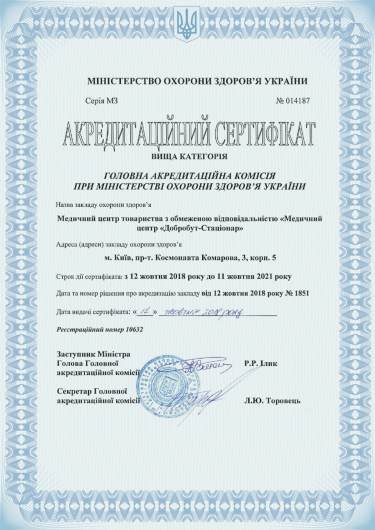
Accreditation certificates

of Dobrobut clinic chain
Accreditation certificates in more detail

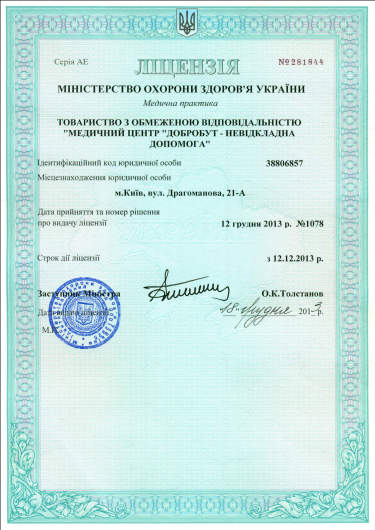
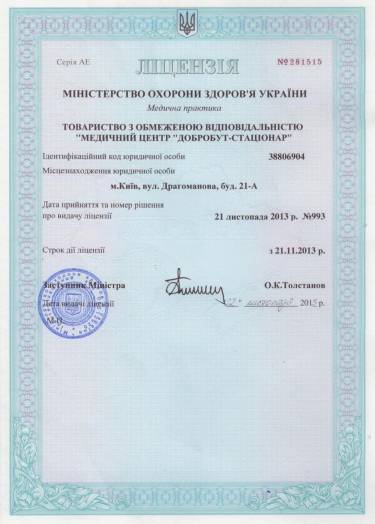
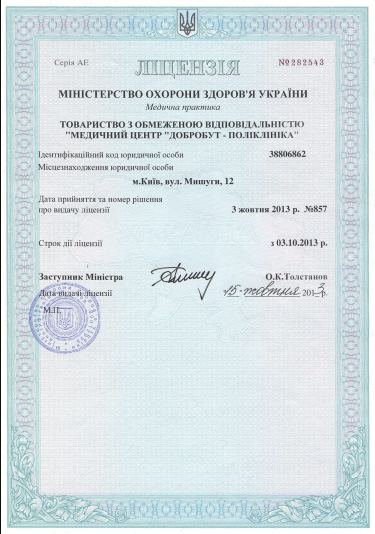
Medical practice licenses

of Dobrobut clinic chain
Medical practice licenses in more detail
Dobrobut
About us
Our customer feedbacks
News and articles
Corporate magazine
Contacts of the MN "Dobrobut"
Dobrobut Foundation
Information
Our certificates
Our licenses
Our awards
Media about us
Financial statements
For patient
Our doctors
Services and prices
Clinic
Hospital
Medical library
Cooperation
International insurance
Partners
For companies
Careers
Contacts
Call Ambulance
5288
Mail
info@med.dobrobut.com
Укр
Рус
Eng
Terms of online services
Public contract for the provision of medical services
Terms of vaccination services
Regulations on the procedure for processing personal data
User agreement
Patient verification
2012 - 2026 Dobrobut MN. All rights reserved
Terms of online services
Public contract for the provision of medical services
Terms of vaccination services
Patient verification
2012 - 2026 Dobrobut MN. All rights reserved
Home
Old Design
Foundation